
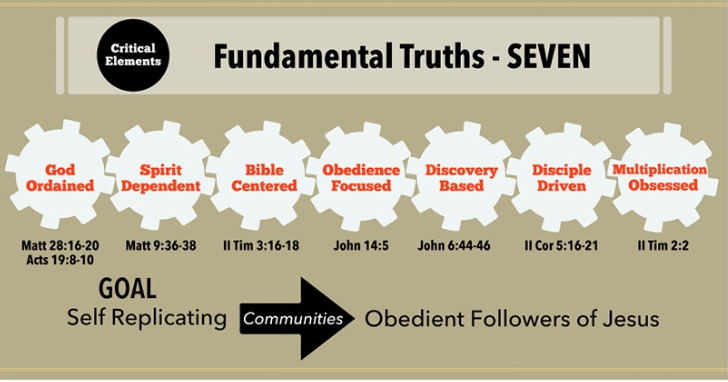
There is well-founded, scriptural grounding beneath movement thinking.
The Movement Principles we practice did not originate as strategies, innovations, or organizational theories. They emerged from re-reading Scripture through a missional lens, paying close attention to how Jesus formed disciples and how the early church multiplied.
For those who want to explore the biblical validity of movement principles more deeply, this page outlines the seven foundational truths that anchor movement thinking in Scripture.
These foundations are not an alternative list of principles.
They are the theological soil from which the movement paradigm grows.
The Seven Biblical Foundations
1. God Ordained
(Matthew 28:16–20; Acts 19:8–10)
Disciple-making movements are not human inventions. They are God-initiated and God-commissioned. Jesus Himself defines the mission, scope, and generational expectation of disciple-making.
What this anchors:
Kingdom Growth over Church Growth
Multiplication as the Finish Line
2. Spirit Dependent
(Matthew 9:36–38)
Movements advance through prayer, discernment, and reliance on the Holy Spirit—not human control or strategic certainty. The harvest belongs to God; workers are sent by Him.
What this anchors:
Qualified → Willing
Kingdom Growth over Church Growth
3. Bible Centered
(2 Timothy 3:16–18)
Scripture is not supplemental—it is central. The Bible forms disciples, equips them for obedience, and provides everything needed for reproduction.
What this anchors:
Simple, Repeatable Strategies
Stop Evangelizing → Start Discipling
4. Obedience Focused
(John 14:15)
Jesus consistently links love, discipleship, and obedience. Biblical faith is not measured by belief alone, but by practiced trust expressed through obedience.
What this anchors:
Knowledge → Obedience
Multiplication as the Finish Line
5. Discovery Based
(John 6:44–46)
God Himself is the primary teacher. Movements assume that people can hear God through Scripture and respond directly to Him—without intermediaries controlling the process.
What this anchors:
Telling → Asking
Simple, Repeatable Strategies
6. Disciple Driven
(2 Corinthians 5:16–21)
Every follower of Jesus is entrusted with the ministry of reconciliation. Disciple-making is not reserved for professionals; it is the normal calling of ordinary believers.
What this anchors:
Qualified → Willing
Stop Evangelizing → Start Discipling
7. Multiplication Oriented
(2 Timothy 2:2)
The New Testament consistently assumes generational transfer. Faithful discipleship results in disciples who are able to teach others also.
What this anchors:
Multiplication as the Finish Line
Kingdom Growth over Church Growth